Home/Business/The OTT Paradox: Sneak Peek Into India’s Subscription Maze
The OTT Paradox: Sneak Peek Into India’s Subscription Maze
Too many OTT platforms in India creating subscription mayhem – consumers are exhausted with rising cost, choices, content fragmentation & subscription fatigue.
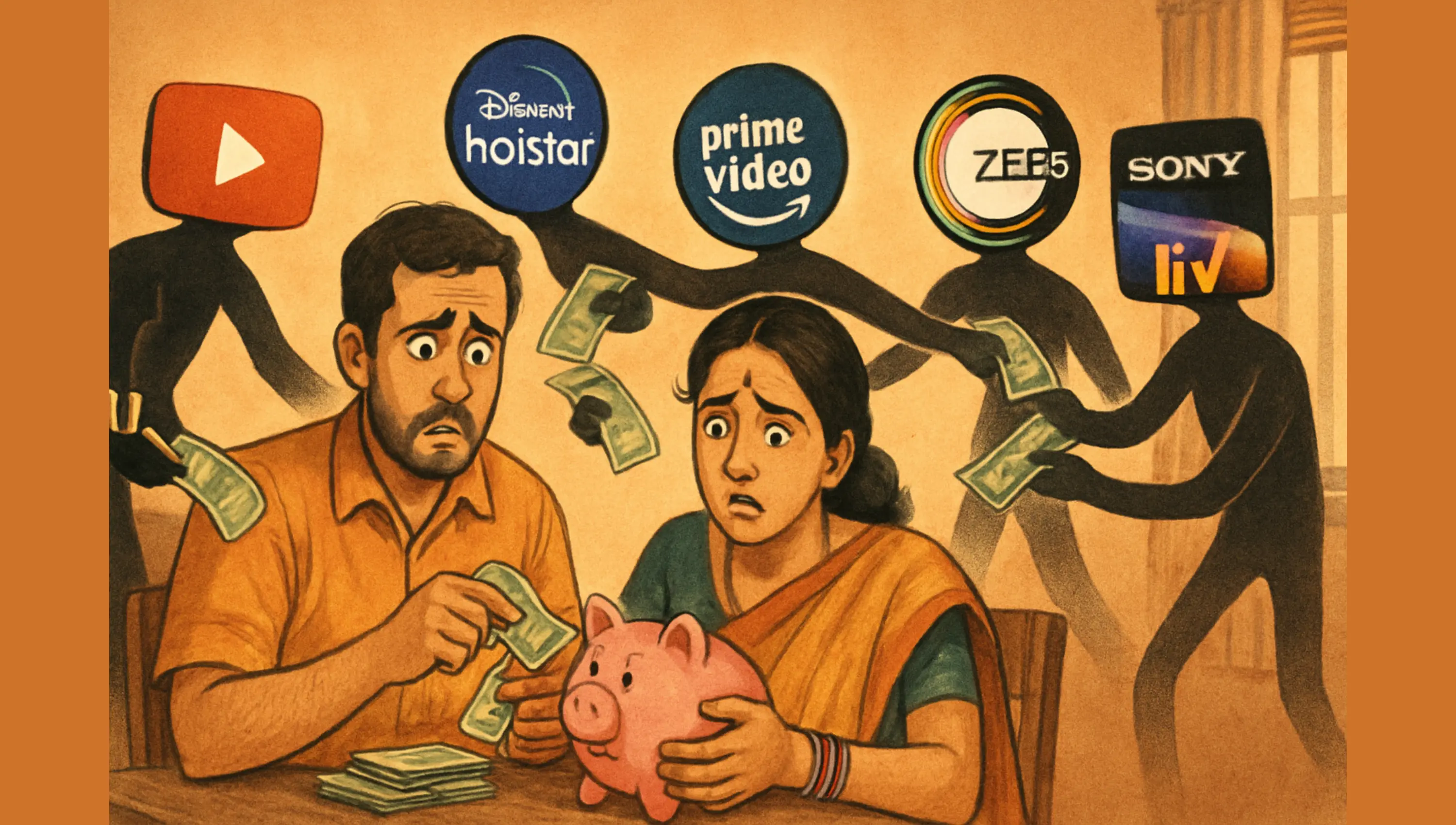
In 2016, Mrinal(name changed), a Kolkata-based IT professional, cut his cable TV subscription with excitement. “No more ads” he recalls. Fast-forward to 2025, and Mrinal finds himself juggling seven different OTT subscriptions, paying ₹2,100 monthly—nearly double his old cable bill—while still watching advertisements on platforms he pays for.
Mrinal’s story isn’t unique. It represents the paradox millions of Indian consumers face today: what began as a liberation from traditional television has evolved into a more complex, expensive, and fragmented entertainment ecosystem.
The Numbers Tell a Stark Reality
India’s OTT market has exploded to unprecedented proportions. The market, valued at USD 4.5 billion in 2024, is projected to reach USD 27.2 billion by 2033, exhibiting a growth rate of 19.7% annually. With over 547 million users in 2025—up from just 210 million in 2018—the industry dominates India’s entertainment landscape. Yet beneath these impressive growth figures lies a troubling trend: subscription fatigue is real and widespread.
The platform hierarchy tells an interesting story. Disney+ Hotstar commands 41% market share with 14 crore subscribers, followed by Amazon Prime Video with 6 crore users and Netflix with 4 crore subscribers. Despite this apparent success, the average Indian household now subscribes to 2.5 platforms, down from 2.8 just two years ago, indicating growing selectivity among consumers.
Urban families typically spend ₹1,500-2,000 monthly on multiple OTT subscriptions, often exceeding traditional DTH costs. This represents a fundamental shift in entertainment economics—from consolidated billing to fragmented micro-payments that slowly drain household budgets.
The Platform Explosion Crisis
“Indian consumers were ambushed by choice. Now they want flexibility, relevance, and consistency.” – Industry expert quoted in Ormax Media study
India hosts over 70 OTT platforms spanning entertainment, news, audio, and gaming. Each platform hoards exclusive content behind its paywall, forcing viewers into a costly game of subscription hopscotch. Want to watch the latest Marvel series? Disney+Hotstar. Craving Korean dramas? Netflix. Following IPL cricket? Back to Disney+ Hotstar or JioCinema. Seeking regional content? ZEE5 or SonyLIV become necessary additions.
This fragmentation has created what experts call “the paradox of choice”—too many options leading to decision paralysis and financial strain. Unlike the consolidated entertainment packages of yesteryear, today’s consumers must navigate dozens of separate billing cycles, login credentials, and content libraries.
The Great Cable TV Exodus and Its Human Cost
Traditional television is witnessing an unprecedented collapse that extends far beyond mere subscriber numbers. India’s pay-TV subscriber base has plummeted from 151 million in 2018 to just 111 million in 2024—a staggering 26% decline. DTH subscribers fell from 67.5 million to 56.9 million, while cable subscribers crashed from 83.5 million to 54.1 million over the same period.
This exodus has had devastating economic consequences that ripple through India’s informal economy. The cable television industry has shed an estimated 577,000 jobs between 2018 and 2025. Combined revenues of major DTH operators and cable providers have dropped 16%, while their profit margins have shrunk by 29%.
The human cost is particularly severe for local cable operators (LCOs), who have seen their workforce contract by 31%, resulting in nearly 38,000 direct job losses. In smaller cities and rural areas, entire families dependent on cable TV distribution networks have lost their primary source of income.
Dilip, a former cable operator staff from Barddhaman, who worked for a LCO shares his experience: “I ran cable connections for 350 + households for over a decade. Today, less than 50 remains .I see there’s no future in this business anymore.”
The Subscription Trap: Death by a Thousand Cuts
The pricing structure reveals the depth of the problem. A detailed(cost as on date of publishing) analysis of major platform costs shows how quickly expenses accumulate :
Platform
Monthly Cost (₹)
Annual Cost (₹)
Key Content
Netflix Premium
649
7,788
International series, Hollywood movies
Amazon Prime Video
299 + 499 (ad-free)
3,588 + 5,988
Prime benefits, original content
Disney+ Hotstar Premium
899
1,499
Sports, Disney content, regional shows
SonyLIV Premium
299
999
Sports, Sony productions
Zee5 Premium
–
699
Regional content, Zee productions
JioCinema Premium
149
1,788
Live sports, reality shows
For a household wanting premium access to just these six platforms, the annual cost reaches ₹22,251—a sum that could fund a year’s worth of premium DTH service with substantial savings remaining.
The psychological impact of these micro-payments cannot be understated. Anuj Gandhi, CEO of Streambox Media, observes: “Subscription fatigue is largely an urban phenomenon. Between urban and rural, the ratio is almost 90:10“. This urban concentration reflects the reality that middle-class families are bearing the brunt of fragmented pricing models.
The Subscription Management Nightmare and Broken Promises
The genuine stress of managing variety of subscription echoes across urban India, where 71% of OTT users subscribe to at least three services, primarily for exclusive content—often just a single show or sporting event. The complexity extends beyond cost management to include multiple login credentials, varying interface designs, different content recommendation algorithms, and the constant cognitive load of deciding which platform might have desired content. Perhaps the most frustrating development for consumers has been the gradual introduction of advertisements into paid platforms. Amazon Prime Video’s recent move to include ads in its standard subscription—requiring users to pay an additional ₹499 annually for ad-free viewing—exemplifies what many see as a “bait-and-switch” strategy.
“Platforms like YouTube and JioStar have normalized ad exposure even within premium content,” This shift has fundamentally altered the value proposition that drew consumers to OTT platforms in the first place.
Netflix has followed suit with ad-supported tiers in global markets, and industry insiders suggest similar moves are inevitable in India. The promise of “pay once, watch without interruption” is gradually eroding across the industry. It feels like we as users have been collectively fooled.
Regional Content: The Double-Edged Sword
India’s linguistic diversity adds another layer of complexity to the OTT landscape. While platforms like ZEE5, SonyLIV, and regional players like Aha (Telugu) and Hoichoi (Bengali) offer rich local content, they also contribute to subscription fragmentation.
This linguistic fragmentation means that families with diverse language preferences often require more subscriptions than those consuming primarily English content, creating an inadvertent economic penalty for cultural diversity.
Recognizing consumer frustration, telecom providers are offering integrated solutions. JioFiber’s ₹599 monthly plan includes 30 Mbps internet, 11 OTT apps, and 800+ TV channels. Similarly, Airtel’s bundled packages provide access to 25+ OTT platforms starting at ₹279.
These bundles can reduce streaming costs by up to 60% compared to individual subscriptions, offering annual savings of ₹6,000-10,000 for typical households. However, adoption remains limited due to several factors including exclusion of premium tiers of popular platforms and geographic restrictions.
A Digital Crossroads Demanding Resolution
The OTT revolution in India stands at a critical juncture. What began as a promise of affordable, convenient, ad-free entertainment has morphed into a complex ecosystem that often costs more and delivers less convenience than traditional alternatives. The industry’s explosive growth—from USD 4.5 billion in 2024 to a projected USD 27.2 billion by 2033—masks underlying consumer dissatisfaction with fragmentation, rising costs, and broken promises about ad-free experiences.
The current model’s sustainability appears questionable. The future likely lies not in further fragmentation, but in consolidation—whether through platform mergers, comprehensive bundles, or hybrid models that balance free and premium content. Until then, Indian consumers must navigate this entertainment labyrinth carefully, treating subscription management as a necessary financial skill rather than a casual entertainment decision.
The question remains: Has OTT truly revolutionized entertainment, or has it simply recreated the problems of traditional television in a more expensive, complex digital format? For millions of Indian families counting their monthly subscription costs while hunting across multiple platforms for their desired content, the answer grows clearer each billing cycle. The industry must remember that entertainment should enhance life, not complicate it. The platform that solves the subscription fatigue problem—whether through genuine bundling, transparent pricing, or innovative consumption models—will likely emerge as the true winner in India’s evolving entertainment landscape.
As AI industries keep navigating through monopolies, this editorial explores whether artificial intelligence can transition from a Silicon Valley elite to a public good.
While the Vande Bharat Sleeper represents a technological leap, the 'rust of old habits'— corruption and a lack of civic sense still corrode our path toward progress.
Tracing AI’s rapid rise and the recent Grok controversy - without urgent, measured caution, the promise of generative intelligence risks becoming an uncontrollable crisis.