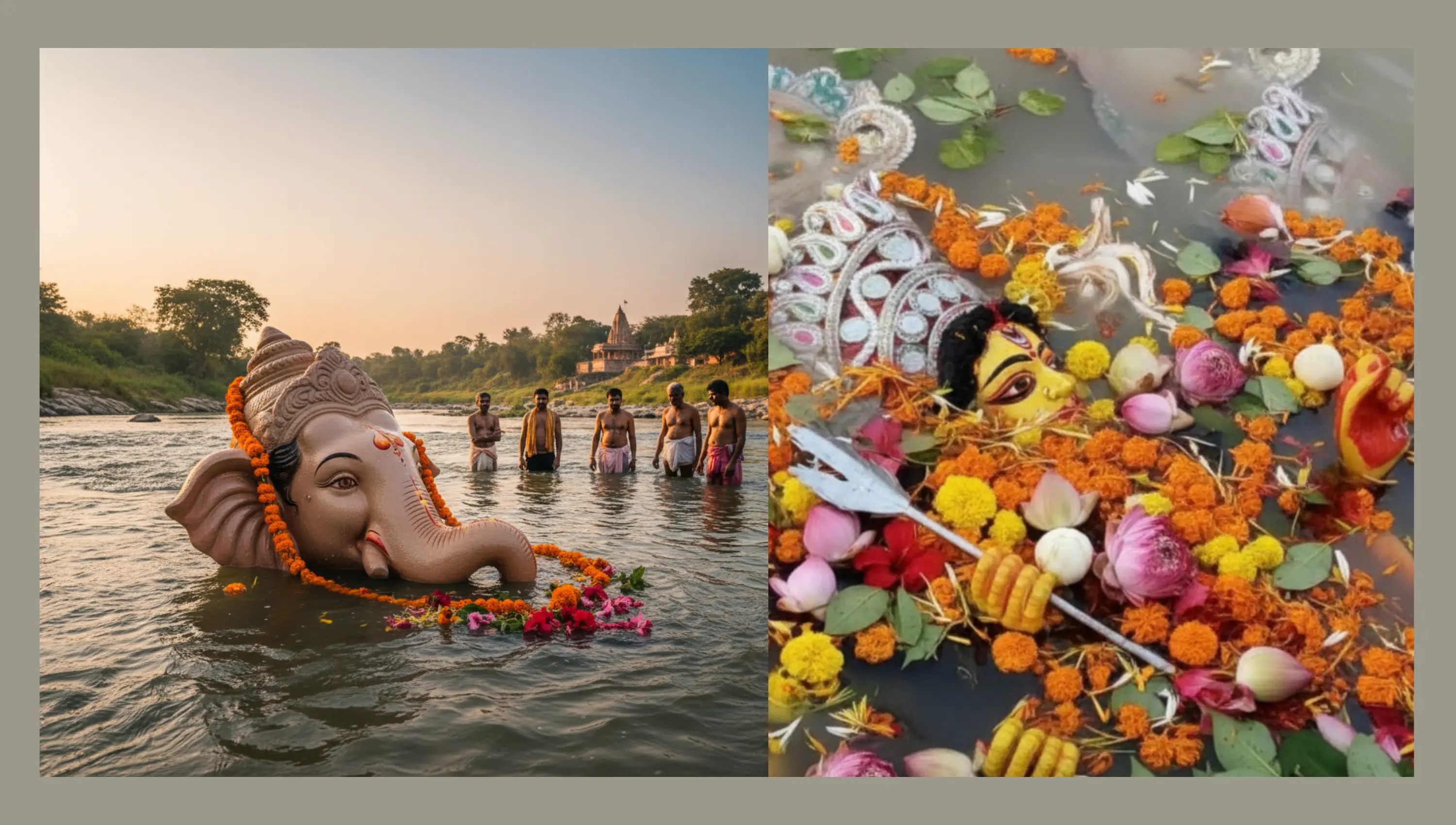
The streets will soon echo with the beats of dhak, chants of prayers, and dazzling lights. As West Bengal, along with the rest of India, gears up for a vibrant festive season — Durga Puja in Bengal, Chhath in Bihar, and Diwali across much of India — a lingering question remains: Are our rituals making our planet harder to live on?
India’s water bodies — already strained under the weight of urban pollution — face an additional festive onslaught. Idol immersion rituals, accompanied by thermocol, plastic flowers, toxic paints, and garlands, gradually choke aquatic life.
Microplastics and Fish: The Invisible Threat
Recent research paints a stark picture. Microplastics have been detected in human blood, saliva, and even breast milk — marking a new stage in pollution’s reach into the food chain. In India, plastic waste in water bodies stands at an estimated 26,000 tons daily. One route of concern: the fish that feed millions. According to Goswami & Datta Ray (2025), an average serving of fish may contain up to 123 microplastic particles, with ingestion linked to DNA damage, endocrine disruption, and declining fish populations. These plastics often contain persistent organic pollutants (POPs), accumulating in fish muscle where humans consume them.
Microplastic pollution’s entry points are numerous, including idol immersion debris, untreated drainage, domestic dumping, and plastic-laden festival decor.
The Scale of Durga Puja:
Gone are the days where idols were made out of only mud and herbal dye. With increase in prices of naturals substances, and rampant use of plastics in our everyday’s life, idols now contain lots of plastic, plaster of paris(pop), synthetic stuffs – the paints often containing heavy metals like lead.
West Bengal is gearing up for the upcoming Durga Puja. Thanks to UNESCO’s Intangible Cultural Heritage tag in 2021, which has infused the festival with renewed vigour and grandeur. The sheer scale is staggering: more than 40,000 community pandals spring up across the state, turning neighborhoods into art installations and centers of joy. Kolkata alone hosts over 3,000 pujas, each with its own character and crowd-pulling creativity—and if one counts family and private celebrations, the numbers climb even higher. State Power Minister Aroop Biswas recently said, “This year, around 49,000 puja committees have applied for power supply, compared to 47,275 last year,” showing how the celebration is expanding year after year.
With UNESCO recognition, Durga Puja has only grown more dazzling and ambitious. Bigger pandals, elaborate themes, and wide participation have become the new norm. But this growing spectacle also brings new challenges. Environmentalists are voicing concerns as the number of idols and festivities increases, adding to pollution in the city’s rivers and public spaces. Finding a balance between tradition, community spirit, and sustainability is now part of the conversation around Bengal’s most beloved festival.
The Bengal Chapter: Fueling Both Celebration and Pollution
Despite Calcutta High Court orders mandating quick post-immersion clean-ups, government data confirms that the water’s biochemical oxygen demand (BOD) rises significantly even in this short period — a sign of suffocated aquatic ecosystems. By the time, the idol has been picked up, damage has already been done. The “Shera Sharad Nirman Puja Puraskar” was introduced to incentivize lead-free paints, but only about 500 puja committees ordered eco-safe idols as of 2022 — a fraction of the total.
Durga Puja which was once a community festival, is slowly turning into a personal or small group level celebration, with new barawari pujas springing up. The government lumpsome honorarium to puja committees ,which has been increased to 1.10 lakhs rupees has given a fresh surge of enthusiasm in formation of new pandals and clubs. More pandals means more celebrations and much more pollution in disguise. This increase in honorarium will cost ₹495 crore to the State exchequer.
Notably, The Mamata Banerjee government had introduced this honorarium to committees organising Durga Puja in 2018, promising a sum of ₹10,000 to each club. In seven years the grant has increased by 11 times.
In West Bengal, environmentalist Subhas Dutta notes,
“Every year we face the same tragedy — rules exist but are hardly followed. Unless communities take ownership, our rivers will remain dumping grounds.”
Comparative State Responses: Innovations and Impacts
Delhi and Karnataka have introduced innovative measures to curb pollution, with Delhi creating 80 artificial ponds for the purpose of Ganesha and Durga puja and a system of recycling of water to combat Yamuna pollution .
Karnataka, renowned for its grand Ganesha Puja, has followed similar eco-friendly steps by lining the bottoms of water bodies with artificial materials to minimize contamination. Mobile immersion units brought the experience closer to devotees’ homes. At Ulsoor Lake, a major immersion site, government authorities maintain vigilant monitoring. According to an eyewitness account, ancillary such as flowers, paper, and ashes was carefully collected and disposed of in designated BBMP containers, alongside constant cleaning efforts on the water.
Mumbai has also set a commendable example. According to a Times of India report, 98% of Ganpati idols this year were immersed in 298 artificial tanks—a significant increase from previous years. The Bombay High Court mandated that plaster of Paris idols up to 6 feet tall must be immersed only in artificial ponds during Ganpati and Navratri festivals. Consequently, the state government allocated ₹35 crore for the creation of additional artificial tanks, increasing the number of immersion sites from 204 in 2024 to 298 in 2025.
A Call for Honest Vigilance
As the chants fade and the pandals come down, what remains in our ponds and rivers is not devotion but debris — a silent testament to our neglect. The grandeur of our festivals must not become the graveyard of our water bodies. If Mumbai can achieve a near-total shift to artificial immersions, why can’t Bengal — with its UNESCO-recognized grandeur — set an example to the world? The government should ramp up it’s vigilance game, stricter actions and penalty should be enforced. The choice is stark.
This Durga Puja, Bengal can either celebrate heritage responsibly or once again push its rivers a step closer to death. As the dhak sounds louder and the idols are readied, the question stays: Will we honor the Goddess while killing the rivers she resides in, or will Bengal lead the way in celebrating without destruction?