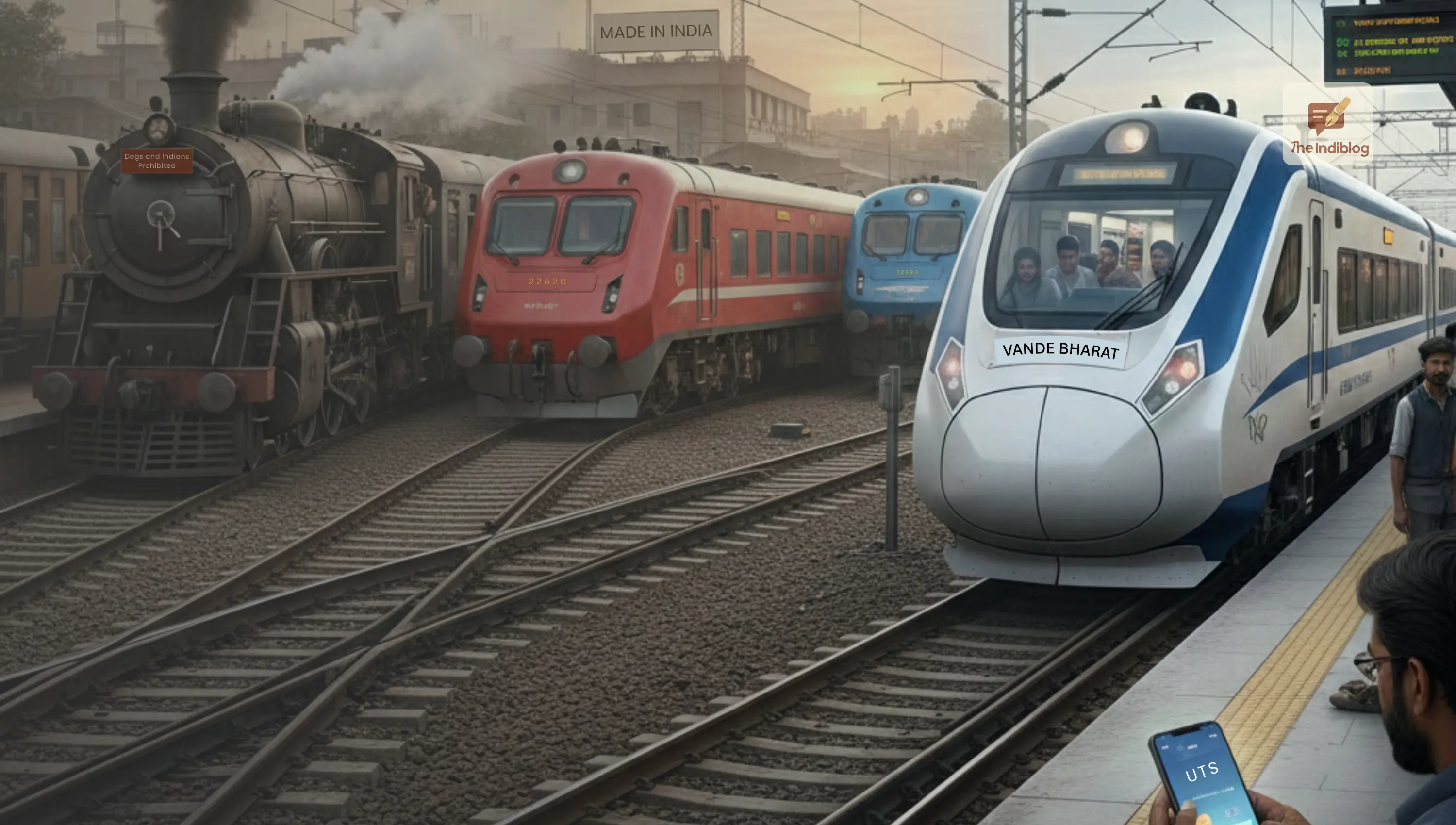
On a humid afternoon in April 1853, when carriages bellowed black smoke on the 34 kilometer stretch between Bori Bunder and Thane, few realized that the 14 iron carriages wasn’t just transporting people; it was transporting a new idea of India. For the British, it was an instrument of extraction and control. For the subcontinent, it became an unintended nervous system that would eventually help coordinate a freedom struggle.
Today, nearly 173 years later, as the sleek nosed Vande Bharat Sleeper glides out of Howrah station towards Kamakhya, effectively banishing the rhythm of the past, we must pause. We must look at this giant- the Indian Railways, not just as a transport utility, but as the most accurate mirror of our civilizational evolution. We have moved from coal dust to aerodynamic nose cones, from natives not allowed to Make in India. But beneath the glossy exterior of our new elite trains, the rust of our old habits- corruption, caste dynamics, and a profound lack of civic sense still corrodes the tracks.
The Unintended Equalizer: Battling The British Raj And The Caste
History is often written in the corridors of power, but in India, it was forged in third-class compartments. The British introduction of the railways was never an act of benevolence; it was an economic necessity for the Empire. Yet it inadvertently struck the first hammer blow against India’s rigid caste stratification.
In the late 19th century, the untouchability that plagued our soil faced a logistical nightmare on the platform. The train did not care for your Gotra (equivalent to lineage) or your Jati (equivalent to caste). When the whistle blew, a Brahmin had to sit next to a Dalit, a merchant next to a laborer. It was a forced integration that terrified the orthodoxy more than the British laws did. Mahatma Gandhi used this very network to stitch a fragmented nation into a political whole. The railways, quite literally, gave the freedom movement its legs.
However, let us not romanticize the past. The discrimination was systemic. First class carriages were often marked for Europeans only, a humiliation that famously radicalized Gandhi in South Africa and resonated on Indian soil. We fought the British for the right to sit in those cushioned seats. We won the train, but did we win the battle for dignity within it? Even today, while the passenger cabins have become democratic mixing grounds, the administrative machinery has often been accused of perpetuating old hierarchies.
The Rot Within: A Legacy Of Corruption And Favoritism
We must be direct, even if it is uncomfortable. The Indian Railways, for all its romanticism, has been treated by successive governments not as a service, but as a political property.
For decades, the Railway Ministry was the ultimate prize in coalition politics: a tool for patronage rather than progress. We have witnessed the infamous “transfer posting” industry, where lucrative positions were auctioned to the highest bidder. For instance, the 2013 case involving Indian Railway Minister Pawan Kumar Bansal’s nephew, Vijay Singla. Even in 2026, as we celebrate digital recruitment, the specter of the “bribe” looms. Reports from Pune and Western Railway exposed recruitment rackets and exam rigging where technology like remote access software was used to manipulate results. The method has evolved from cash in suitcases to cryptocurrency and digital rigging, but the intent remains the same: to bypass merit.
The “Emergency Quota” (EQ) system for tickets remains another glaring example of dualism. In a country that claims to be a democracy, why does a significant chunk of berths get set aside for VIPs and their extended entourages, while the tax paying common man fights a digital war on IRCTC at 10:00 AM? The VIP culture of the Lal Batti may have been banned on cars, but it is alive and kicking on our reservation charts.
The Speed Wars: From Rajdhani Royalty To Vande Bharat Swagger
If you want to understand India’s economic aspiration, look at its elite trains.
In 1969, the Rajdhani Express was born. It was the “King” of the tracks- red, regal, and exclusive. It catered to the socialist elite, the bureaucrats, and the upper-middle class. It was a symbol of a sluggish but stable India, content with 120 km/h.
Then came the Shatabdi in 1988, the brainchild of Madhavrao Scindia. It represented the emergence of a business class that needed to travel fast during the day. It was the “Queen,” efficient and polite.
In 2009, Mamata Banerjee gave us the Duronto– the rebellious teenager. Paint-splashed yellow-green exteriors, point-to-point connectivity, no stops. It was a chaotic but brilliant attempt to bypass the system’s lethargy.
But the Vande Bharat Express (and its new Sleeper variant) is different. It is the Gen Z icon. It is engineless, self propelled, and unapologetically modern. It doesn’t just want to reach the destination; it wants to look good doing it. With the Vande Bharat Sleeper now hitting the tracks, offering safety features like the KAVACH system and crash buffers that Rajdhani lacked, we might be seeing the sunset of the locomotive hauled era. The shift is psychological. The Rajdhani was about comfort; the Vande Bharat is about pride. The Integral Coach Factory (ICF) in Chennai, once a quiet production unit, is now a global hub of frugal engineering.
The Sophisticated Spine: UTS And The IT Revolution
While we marvel at the hardware, the true revolution is in the software. The sheer scale of moving close to 24 million people daily, nearly the population of Australia – requires a digital backbone that is nothing short of miraculous.
The Centre for Railway Information Systems (CRIS) is the unsung hero here. Remember the days of serpentine queues for an unreserved ticket? The UTS (Unreserved Ticketing System) app has quietly killed that indignity. The transition from physical ledgers to the cloud, the FOIS (Freight Operations Information System) that tracks millions of tons of cargo in real time, and the AI-driven maintenance schedules are the “hidden” sophistications the public rarely sees.
We have moved from a time when a station master waved a lantern to a time when an algorithm decides which train overtakes which on the busy Delhi-Howrah line. This digital layer is what prevents the system from collapsing under its own weight.
The Mirror In The Washroom: A Crisis Of Civic Sense
And yet, here lies the tragedy. We have built world class trains, but we have not yet built world class passengers.
The Vande Bharat Express, our national pride, has been pelted with stones in multiple states. Why? What primal anger drives a citizen to shatter the glass of a train that was built with their own tax money? It is a complex mix of political vandalism and a complete lack of ownership.
Step inside the toilets of even our premium trains an hour into the journey. The gleaming fittings are often stolen or destroyed. The floors are littered. The “magpie syndrome”- stealing headphones, towels, and even taps persists. We demand the infrastructure of Europe but treat it with the civic sense of a medieval mob.
The suburban networks of Mumbai and Chennai tell a similar story. The introduction of AC Locals was a game changer, offering a respite from the sweltering heat and the super dense crush load. Yet the discipline required to maintain these assets is missing. We spit paan (betel leaf) on automatic doors; we block sensors. The trains have evolved, but the passenger is still fighting a survival battle that manifests as aggression against public property.
The Track Ahead
The Indian Railways is no longer just a transport provider; it is a geopolitical statement. It has overcome the colonial hangover, the technological discrimination of the West, and the sluggishness of the License Raj. The Vande Bharat Sleeper is not just a train; it is a declaration of intent.
But steel and silicon can only do so much. The final frontier for the Indian Railways isn’t a bullet train speed of 350 km/h. It is the mind of the Indian passenger and the integrity of the Indian administrator. Until we can stop the bribery in recruitment and stop the stone pelting on the tracks, we will remain a nation with first-world engines pulling third-world mindsets.
The whistle has blown. The signal is green. The train is moving. Are we?