A Humble Beginning in a Land of Giant Players
A decade or two ago, ceiling fans in Indian homes symbolized something basic and reliable—functional, yes, but uninspiring. Dull colors, tired designs, and a tech backbone virtually untouched for half a century. For a market long ruled by legacy marks—Crompton, Bajaj, Orient, Usha, and Havells—change seemed both unnecessary and impossible.
Enter 2012: Two young minds, Manoj Meena and Shibam Das of IIT Bombay, dreamt bigger. Joined by childhood friend and marketing visionary Arindam Paul (IIM Indore), they saw an unmissable blind spot: Why should India, a land of relentless summers, settle for boring, power-hungry fans? As Paul reflects, “Fans hadn’t changed in India for more than 50 years—same induction motors, same paint jobs. We saw it as the opportunity of our generation.”
Their prototype—a sleek ceiling fan powered by Brushless Direct Current (BLDC) motor—didn’t just spin blades; it spun the entire industry’s sense of what was possible. In June-July of the founding year, the trio realized their technology could truly “move” India toward a more efficient, modern, and bold future
The Long History of Ceiling Fans
The story begins in 1882, when German-American inventor Philip Diehl adapted his sewing machine’s electric motor to spin fan blades, creating the world’s first electrically powered ceiling fan. A few years later, in 1886, John and James Hunter introduced a water-powered model, followed by alternating current motor adoption in New York by 1896. By the 1920s, ceiling fans had become symbols of comfort in America, now with four blades that ran quieter and pushed more air. Their popularity waned in the US by the 1950s with the rise of air conditioners, but in tropical nations like India, they became indispensable for daily life. The next shift came in the 1970s and 1980s, when Indian players such as Crompton-Greaves and Encon advanced energy efficiency with induction motors consuming about 70–80W. The true leap, however, emerged with BLDC motor technology: though invented in 1962, it only entered ceiling fans in a big way with Emerson Electric in 2009. Indian innovators soon seized this opportunity, with pioneers like Versa Drives (Superfan) and later Atomberg cutting power usage to just 28W while retaining airflow and reliability.
What Makes BLDC Fans Different?
BLDC stands for “Brushless Direct Current.” Unlike traditional fans, these motors:
- Use electronic controllers instead of carbon brushes, eliminating friction and mechanical wear.
- Incorporate permanent magnets in the rotor for greater efficiency.
- Enable precise modulation of speed—using only as much energy as needed.
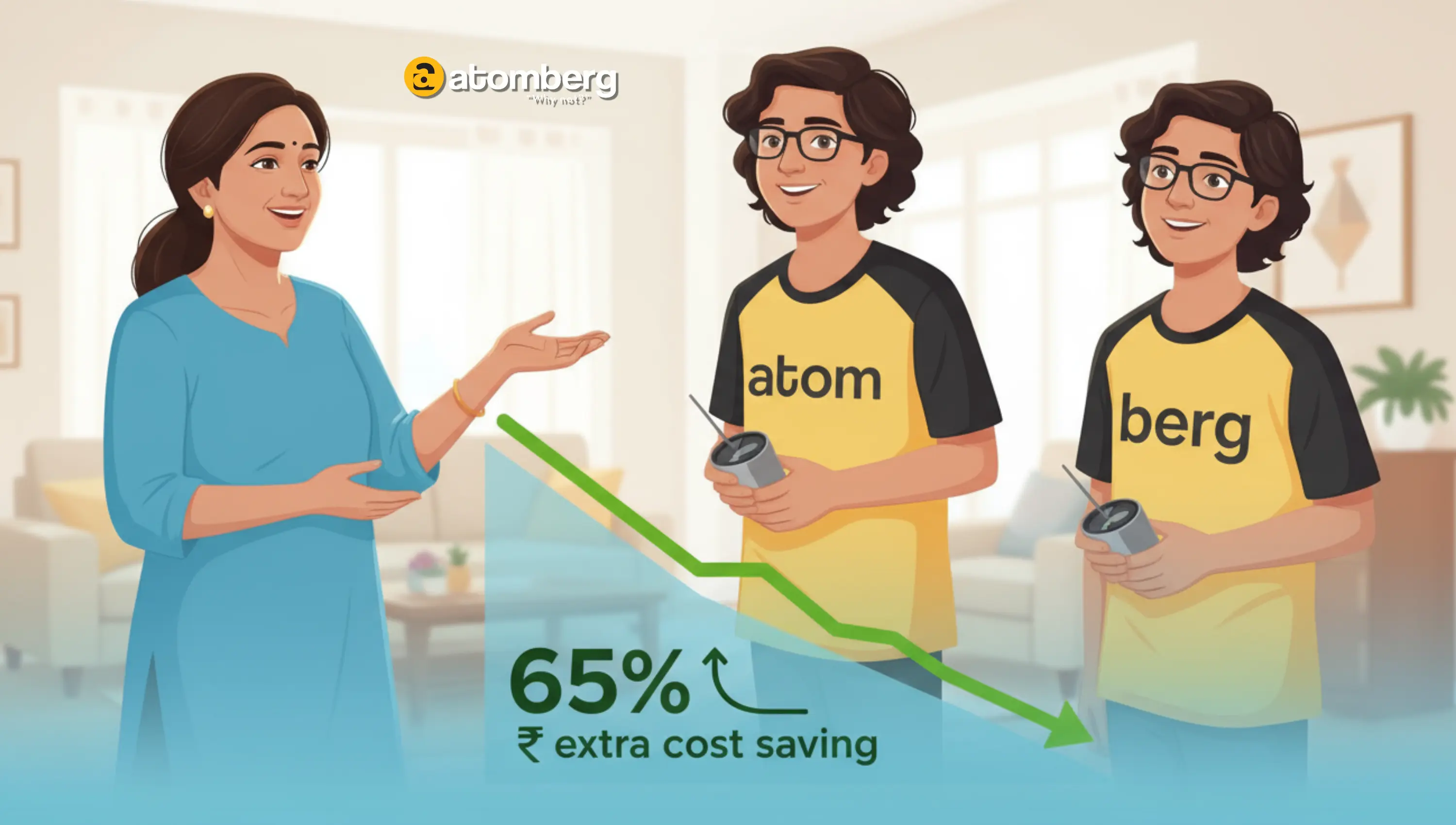
Atomberg’s innovation delivered up to 65% energy savings. “This technology isn’t just faster or sleeker—it’s responsible. People want appliances that are future-ready, kinder to their pocket and the planet,” says Arindam Paul in a 2024 interview
The Sleeping Giant: India’s Fan Market
India is the world’s second-largest fan market:
- 88% of Indian households now own ceiling fans.
- In 2024, the country had 43.1 million units sold per year, projected to reach 52 million by 2033 at 2% CAGR.
- Fans account for about 40% of residential electricity consumption.
- Southern India dominates in sales, but the fastest growth now comes from rural electrification, rising incomes, and government housing pushes.
- The average Indian fan is cheap—Rs 1,800–2,000—but basic in both form and function.
Atomberg entered this saturated marketplace with a simple question for India’s aspirational, energy-conscious middle class: Why not pay Rs 3,000 upfront to save energy and money for years?
Trials by Fire: Early Days of Atomberg
No great story skips hardship and risk. The first years for Atomberg were fraught with challenges:
The team nearly ran out of capital, a tough reality for any hardware startup.Customers, especially institutional buyers, delayed payments so long that at one point, Atomberg came dangerously close to shutdown. Distribution and channel partnerships were difficult to crack—why would dealers risk their shelf space on an unknown, high-priced fan?
In this storm, Atomberg sketched its first successful path: First started with gorilla fan, it focused on B2B. They sold to schools, hospitals, the Indian Railways, and Tata. These buyers did the math on energy savings and long-term costs, making Atomberg’s value proposition a no-brainer for them. Even early customers in heavy-duty industries and ceramics—where dozens of fans run day and night—became Atomberg’s digital brand champions, sharing testimonials on YouTube and review forums.
The Genius of “Why Not?”: Turning the Market Emotional
2020 marked a pivotal twist in Atomberg’s journey. The brand needed not just buyers but believers—Indians willing to question their long-standing biases.
The “Why Not?” campaign took off positioning Atomberg as a disruptor . In a memorable move, Atomberg cast a pair of twins, “Atom” and “Berg,” to ask why Indian fans couldn’t be stylish, smarter, remote- or voice-controlled, and ultra-efficient? The campaign was digital-first: quirky 25 seconds YouTube shorts to question conventional thoughts, sharp influencer tie-ups on Instagram, real life testimonials, and viral “remote control convenience” stories.
“We made innovation relatable,” Paul explained in a 2025 podcast. “It wasn’t about just Watt savings, it was about letting people ask: Why not me? Why not here?”
A Mix Of Digital and traditional tactics: From Digital start to Mainstream Hero
Atomberg cracked a code rarely mastered by Indian appliance startups: blend digital-first branding with deep offline presence.Their first wins came online—Amazon, Flipkart, then their own web portal, quickly notching up over 25% of sales via e-commerce, benchmarked against a 2-5% industry average.
By 2025, Atomberg expanded to 30,000 retail stores across 400 towns, reaching every corner from Kerala to Punjab.They sold over 10 million fans, now present in more than 7 million Indian homes.Their marketing spend remained modest (under 10% of revenue), with major investments committed to R&D and after-sales service—a playbook Paul repeatedly touts in startup forums and interviews.
Financial Meteor: The Numbers Speak
Atomberg’s growth curve is nothing short of entrepreneurial folklore:
Their next chapter? Atomberg has entered the kitchen appliance like bldc motor powered mixer grinder to water purifier space, launching India’s first adaptive purifier—a leap that demonstrates their ambition to own the home, not just cool it
The road ahead
Atomberg positioned itself as a premium and innovative brand, charging a higher price but justifying it through value and long-term cost savings . As Atomberg stands on the threshold of another exciting chapter—expanding its presence across offline stores, launching into new smart appliance categories, eyeing international markets, and priming for a potential IPO—the story is far from over. The questions now linger: Can a young, disruption-driven Indian brand sustain its pace of innovation, outpace global competitors, and redefine what it means to be a homegrown multi-category leader? Or does the true challenge lie in maintaining the spirit of asking “Why not?” even as the company grows larger and more complex?
Perhaps the most memorable lesson from Atomberg’s journey is this: great businesses are built not just on products or margins, but on the courage to challenge routines and inspire new questions—turning ordinary appliances into milestones in modern living. So, as homes across India (and perhaps abroad) cool under Atomberg’s fans, one must wonder—what ordinary object in our daily lives is waiting for its own extraordinary reinvention?