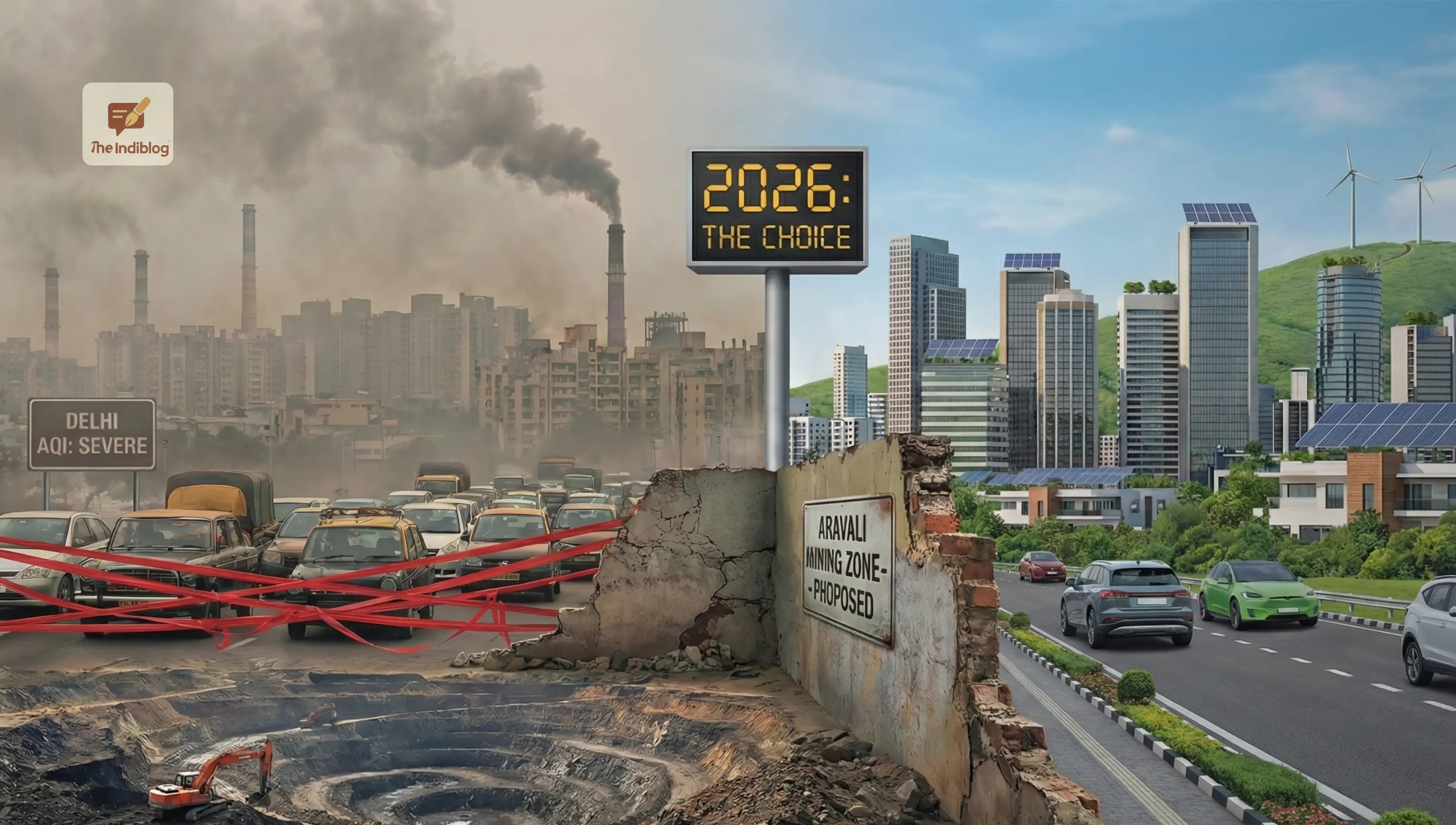
As we step into 2026, the view from Raisina Hill is complex. On one hand, India stands tall as a burgeoning economic powerhouse, chasing a $5 trillion dream with the vigour of a tiger on the prowl. On the other, the view is quite literally obscured by a thick, acrid smog that blankets the national capital—a grim reminder that our ascent is fueled by a diet that our lungs can no longer digest.
We step into this new year carrying the baggage of unkept promises and the momentum of genuine progress. The narrative of India’s decarbonisation is no longer just about diplomatic handshakes at COP summits; it has moved to the streets of Delhi, the mining pits of the Aravalis, and the boardrooms of a rapidly industrialising nation. The question for 2026 is not if we will decarbonise, but whether we can dismantle the economic, social, and governance red tape that threatens to trip us up.
The Ledger Of Promises: 2070 And The Interim Sprint
Let us look at the ledger. At the Glasgow COP26, Prime Minister Narendra Modi stunned the world with the ‘Panchamrit‘ pledge, setting a Net Zero target for 2070. The interim milestones for 2030 were equally ambitious: 500 GW of non-fossil energy capacity, meeting 50% of energy requirements from renewables, and slashing the economy’s carbon intensity by 45%.
By mid-2025, reports indicated a slowing in India’s emissions growth to just 0.3% in the first quarter, a signal that the curve is bending. Coal’s share in power generation dropped to around 64%, down from 70% just two years prior. We are witnessing a renewable energy revolution, with solar parks carpeting the arid plains of Rajasthan and wind turbines punctuating the coastlines.
However, the “Net Zero” horizon is distant, and the path is littered with immediate contradictions. India’s hunger for energy is insatiable. To power the factories that foreign companies are rushing to build—courtesy of our liberalised trade policies and “Make in India” calls—we are still burning coal at a frantic pace. The duality is stark: we are building the green future with one hand while shovelling coal with the other.
Governance Red Tape: The Aravali Story
Nowhere is the conflict between growth and governance more visible than in the Aravali mountain range. This ancient geological shield, which protects the National Capital Region (NCR) from the encroaching Thar Desert, has been reduced to a real estate ledger entry.
Just weeks ago, in late 2025, the fate of these mountains hung “at the peril of a pen stroke.” A Supreme Court judgment in November 2025 attempted to redefine what constitutes a “hill” (limiting it to 100 meters in height), a technicality that threatened to open vast swathes of this fragile ecosystem to mining. While the Court issued a stay on its own order in December 2025 following public outcry, the episode exposed a terrifying vulnerability.
If our definition of “forest” and “mountain” changes to suit the mining lobby, our climate goals are merely paper tigers. The relentless push for mining materials to build our smart cities is hollowing out the very lungs that allow those cities to breathe. This governance flip-flop sends a confusing signal: are we guardians of the ecosystem, or auctioneers of it?
The Choking Capital: A Social Emergency
If the Aravalis are the silent victims, the citizens of Delhi are the gasping witnesses. The winter of 2025 has been another season of respiratory despair. Despite the “best ever” average AQI recorded between January and August 2025—thanks largely to favourable meteorology—the winter erased those gains.
The data is damning. For consecutive years, Delhi’s AQI has soared into the ‘Severe’ category (400+) during winter months. We have seen the city placed under varying degrees of “closure” for over 40 days annually—schools shut, construction halted, and the Odd-Even vehicle rationing rule dusted off like a seasonal ritual.
The tragedy is the normalization of this crisis. Governments change, but the smog remains. The Graded Response Action Plan (GRAP) has become a reactive bandage on a festering wound. When schools close, it is not just an educational loss; it is a social admission of failure. We are raising a generation that equates winter not with picnics, but with air purifiers and inhalers. This is the “social red tape”—an apathy that accepts toxicity as the price of residence.
A Global Perspective: Paris – 10 Years On
Was the 2015 Paris Climate Convention a failure? It is fashionable to say yes, citing the lack of penalties and the breached 1.5°C threshold. However, a nuanced look reveals a different truth. As noted in recent analyses the Paris Agreement has not failed; it has merely been insufficient. It succeeded in making carbon reduction a global lexicon but failed to enforce the urgency required.
We can look to the African continent for lessons in resilience. Countries like Kenya and Ghana are leapfrogging the fossil fuel age, driven by initiatives like “Mission 300” which aims to bring electricity to 300 million people by 2030, largely through decentralized renewables. If African nations, with far fewer resources, can aggressively pursue solar sovereignty, India’s excuse of “development first” holds less water. The Global South is moving; India must lead, not just follow.
The EV Paradox And The Commercial Gap
Closer to home, the transition to green mobility offers a glimmer of hope, shadowed by economic realities. The government’s push for Electric Vehicles (EVs) through the FAME and PM E-DRIVE schemes has successfully subsidized two-wheelers, making the electric scooter a common sight.
But the heavy lifting—quite literally—is done by commercial vehicles. Trucks and buses, the diesel-guzzling arteries of our economy, are yet to see mass adoption of electric variants. Why? Because without massive policy intervention, an electric truck costs significantly more than its diesel counterpart. The “economic red tape” here is the upfront cost.
Furthermore, we must address the “green paradox.” Although ,E V battery prices have dropped, but the manufacturing process remains carbon-intensive. We are shifting emissions from the tailpipe to the mine and the factory. True decarbonisation requires a circular economy for batteries, something our policy framework is only just beginning to address.
The Verdict For 2026
As we navigate 2026, the goal of a multi-trillion-dollar economy must not become a climate challenger. The two must be allies.Sustainability cannot be a sidebar in the budget document; it must be the font in which the budget is written.For Policymakers – Stop the policy seesaw. Investors and ecosystems both need stability.For Industrialists – Green energy is no longer charity:it is a survival strategy. The world will soon tax carbon heavily (CBAM is just the start) – adapt or perish.For Citizens-The red tape in our minds must be cut. Pollution is not an act of God; it is a result of our choices—from the vehicles we drive to the waste we burn.
The path to 2070 is long, but the deadline for 2026 is immediate: Breathe. If we cannot ensure clean air today, the promise of Net Zero in forty years is nothing but smoke.