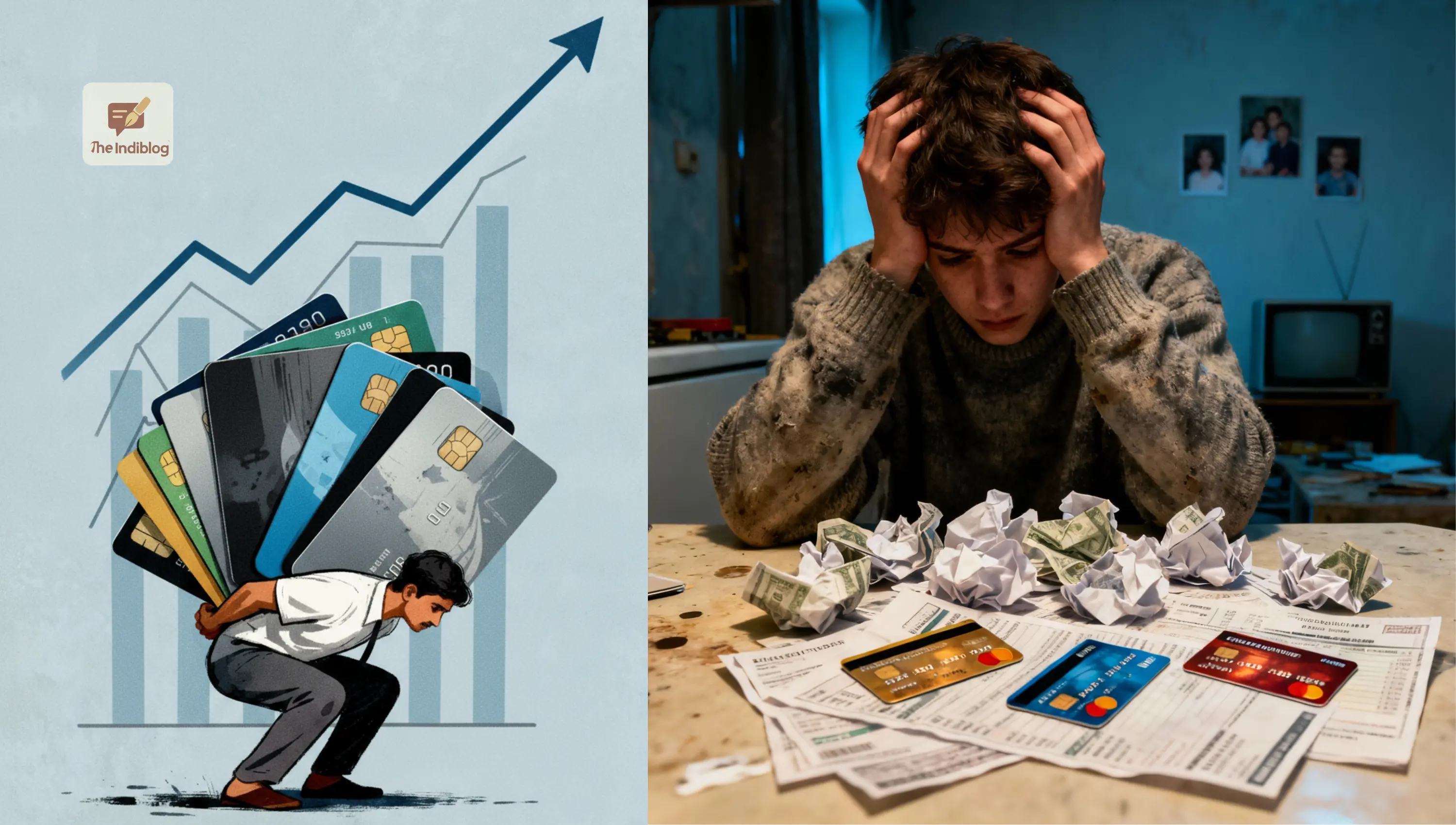
The convenience of a simple swipe has morphed into a financial nightmare for millions of Indians. While credit cards were once symbols of financial sophistication and purchasing power, they have quietly transformed into instruments of debt accumulation, trapping unsuspecting consumers in a cycle that’s increasingly difficult to escape.
The numbers tell a story of mounting distress. Unpaid credit card bills in India surged 44% year-on-year to ₹33,886 crore by March 2025, according to CRIF High Mark data. This represents debt that has remained unpaid for 91 to 360 days—a period that banking regulations categorize as non-performing assets. The most alarming pressure lies in the 91–180 days overdue category, where unpaid dues climbed to ₹29,983.6 crore from ₹20,872.6 crore a year earlier, nearly doubling from two years prior. These aren’t merely statistics; they represent families struggling with interest penalties, damaged credit scores, and diminishing financial security.
The Credit Card Boom
The proliferation of credit cards has been nothing short of explosive. The number of credit cards in circulation more than doubled from 5.53 crore in December 2019 to 10.80 crore by December 2024, representing a remarkable 95% increase in just five years. By May 2025, active credit cards reached 11.11 crore, up from just 6.10 crore in January 2021. In stark contrast, debit cards witnessed only marginal growth, rising from 80.53 crore to 99.09 crore during the same period, suggesting a fundamental shift in payment preferences and perhaps, spending habits. [Source]
This growth wasn’t accidental. It was engineered through a sophisticated ecosystem of incentives, digital integration, and accessibility. Outstanding credit card dues climbed to ₹2.90 lakh crore by May 2025, while credit card spending jumped 15% to ₹21.09 lakh crore by March 2025. The Reserve Bank of India data reveals that in July 2025 alone, outstanding dues reached ₹2.91 lakh crore, more than double the ₹1.32 lakh crore recorded in July 2021—a 2.2-fold increase in just four years.
The Irresistible Lure
What fueled this rapid expansion? Banks and fintech companies created an irresistible value proposition through rewards programs, cashback offers, airport lounge access, dining discounts, and shopping vouchers. The emergence of EMI (Equated Monthly Installment) options at point-of-sale terminals allowed consumers to purchase expensive smartphones and consumer durables without immediate financial strain. Buy Now, Pay Later schemes further lowered psychological barriers to spending, making credit feel less like debt and more like deferred convenience.
E-commerce giants like Amazon and Flipkart transformed credit cards into essential shopping tools, offering exclusive discounts and instant EMI options that made expensive purchases appear affordable. Digital platforms like CRED gamified credit card payments, making debt management feel like an achievement rather than an obligation. For millennials and Gen-Z consumers, digital credit lines offered through mobile apps represented financial inclusion and independence.
The Business Of Debt
Behind the glittering rewards lies a lucrative business model built primarily on consumer debt. While banks earn revenue through multiple channels, interest income on revolving balances accounts for approximately 80% of credit card profitability, according to a 2022 Federal Reserve Board study. When consumers fail to pay their full balance within the interest-free period, they trigger interest charges that can reach up to 42% per annum in some cases—or 3.75% monthly, translating to an annualized rate of 45%.
The Merchant Discount Rate (MDR) provides another revenue stream. When a consumer spends ₹1,000 using a credit card, the merchant receives only ₹965 to ₹985, with the remaining 1.5% to 3.5% split among the issuing bank, payment network (Visa, Mastercard, RuPay), acquiring bank, and payment gateway provider. Additionally, banks collect annual fees, late payment charges, cash withdrawal fees, and over-limit penalties—charges that often go unnoticed amid the overwhelming perks marketed to consumers.
The Debt Trap Mechanism
The transition from convenient payment tool to debt trap follows a predictable pattern. Financial literacy remains alarmingly low among Indian consumers, with limited understanding of billing cycles, minimum payment dues, and the compounding effect of credit card interest. A recent study found that financial literacy emerged as a critical moderating factor, with its absence significantly impacting debt management capabilities, particularly among lower-income groups.
Nearly a billion people in India currently lack the financial means for discretionary spending, yet 300 million “emerging” or “aspirant” consumers have begun spending on non-essential goods through increased reliance on credit.The Portfolio at Risk (PAR) metric reveals growing systemic stress. For the 91–180 day overdue category, PAR jumped to 8.2% in March 2025 from 6.9% the previous year, while for 181–360 day overdues, it rose to 1.1% from 0.9% in 2024. Credit card delinquencies in the 91-180 days past due bucket rose by 110 basis points to 7.6% as of June 2024. These increases signal that borrowers aren’t just delaying payments—they’re fundamentally unable to repay.
The Systemic Failure
This crisis exposes multiple systemic failures. The Reserve Bank of India, recognizing the buildup of risks, increased risk weights on consumer credit exposure and credit card receivables by 25 percentage points to 150% for banks and 125% for NBFCs in November 2023. While this regulatory intervention aimed to ensure banks maintain adequate capital reserves against potential defaults, it arrived after millions had already accumulated unsustainable debt.
The real tragedy lies in how credit cards have shifted from luxury items to necessities for basic survival. According to Marcellus Investment Managers, the mid section of India’s tax-paying population has seen income stagnate in absolute terms over the past decade, translating to real income halving when adjusted for inflation. In this environment, credit cards aren’t funding vacations or luxury purchases—they’re covering groceries, medical expenses, and school fees.
The Path Forward
The responsibility for addressing this crisis must be shared. Banks and fintech companies need to move beyond acquisition-focused strategies toward responsible lending practices that assess genuine repayment capacity rather than just credit scores. Mandatory financial literacy initiatives should precede credit card issuance, particularly for first-time users and lower-income applicants.
Regulators must enforce stricter disclosure norms, ensuring consumers understand the true cost of carrying credit card debt beyond the interest-free period. The seductive language of “zero-cost EMI”, “no-cost EMI” and “instant approval” obscures the reality that missed payments can spiral into debt traps within months. For consumers, the message is uncomfortable but essential: credit cards are tools, not income supplements. The promise of convenience comes with a price—one that millions of Indians are now struggling to pay.